
Skip to content
Dallas Fence Company
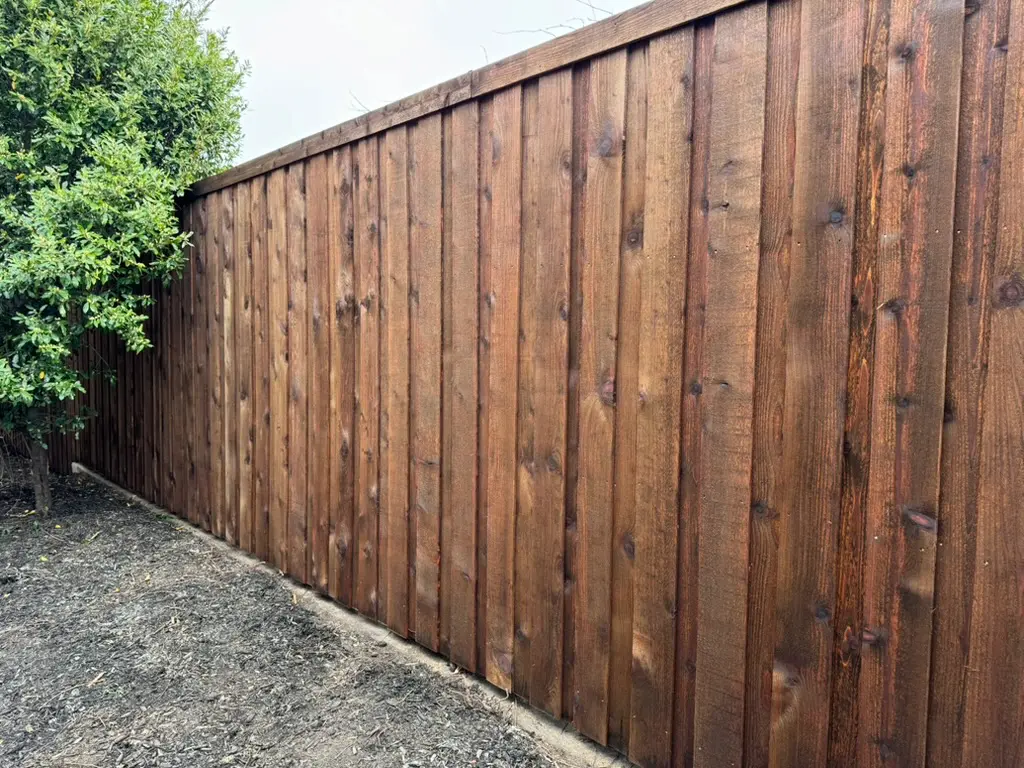
Board-on-board cedar wood fence installed in Dallas, TX
Top Wood Fence Company

Wood Fence Installation in Dallas, TX

Wood fence installation in Dallas, TX. Cedar privacy fences on galvanized steel posts, 5-year warranty. Call (469) 809-2424 for a free estimate.


Wood Fence Installation

01

Premium Wood Fencing in Dallas

A wood fence in Dallas has to survive 100°F summers, the occasional ice storm, and clay soil that swells and shrinks with every wet-dry cycle. Most fences aren't built for that. Ours are.

Dallas Fence Company builds Western Red Cedar fences on galvanized steel posts as standard spec — not an upsell, the default. Every install carries a 5-year workmanship warranty. If a gate sags or a rail pulls loose because of our work, we come back and make it right.

Why Homeowners Choose Us

  • Steel posts on every build — wood posts rot at the ground line and lean when the clay moves. Galvanized steel posts set in concrete don't.
  • Western Red Cedar spec — naturally rot- and insect-resistant lumber, not the flimsy builder-grade picket.
  • 5-year workmanship warranty — longer than the one- or two-year coverage common across DFW, including from the biggest names.
  • Itemized quotes — post type, picket grade, rail count, and tear-out spelled out line by line. Nothing buried in the fine print.

From a straightforward side-by-side privacy fence to a board-on-board showpiece with cap and trim, every build gets the same treatment: plumb posts, tight lines, no shortcuts.

03

Cedar vs. Pine: Choosing the Right Wood

The species you pick decides your fence's lifespan, maintenance schedule, and how it looks in year ten. Two options dominate the Dallas market.

Western Red Cedar

Our recommendation, and our specialty. Cedar carries natural oils that repel insects and resist rot without chemical treatment. It's dimensionally stable — it shrinks and warps far less than pine through North Texas heat cycles. Left alone, it weathers to silver-gray. Stained, it holds a rich reddish-brown for years. Grade matters too: we spec tight-knot cedar pickets rather than bargain-bin boards that split around loose knots as they dry.

Pressure-Treated Pine

The practical play. Pine is chemically treated to resist rot and termites, and it holds up for a while. The trade-off shows up fast in Texas heat: pine moves more, so expect warping, cupping, and cracking sooner. Fine for utility runs and shorter-term fences — just go in with honest expectations.

The Comparison

  • Lifespan — Cedar: 15–25 years. Pine: 10–15 years.
  • Rot resistance — Cedar: natural oils. Pine: chemical treatment.
  • Warping in heat — Cedar: minimal. Pine: common.
  • Maintenance — Cedar: low. Pine: moderate.
  • Dimensional stability — Cedar: high. Pine: lower.

Bottom line: cedar stays straighter, lasts longer, and needs less upkeep year over year. And if you never want to stain anything again, Trex composite fencing is the zero-maintenance route — no staining, ever.

04

Built for North Texas: Heat, Ice, and Black Gumbo Clay

Fence specs that work in milder climates fail here. Three local realities shape how we build.

Thermal cycling. North Texas swings from 100°F-plus summers to sudden winter ice storms. Lumber expands, contracts, and dries out through every cycle, which is why picket grade, proper fastening, and stain matter more in Dallas than almost anywhere. It's also why we favor cedar — it simply moves less.

Expansive clay soil. Much of Dallas, Plano, and Richardson sits on the clay locals call black gumbo. It swells after rain and shrinks hard in drought, and that movement grabs fence posts and shoves them out of plumb season after season. A wood 4x4 in a shallow hole doesn't stand a chance. Our answer: galvanized steel posts set deep in concrete footings, sized for the fence height. The clay still moves. The fence doesn't.

Wind load. Spring storms hit a solid privacy fence like a sail. Full-coverage picket walls carry serious wind load, which is exactly where steel posts and three-rail framing earn their keep.

05

Permits, HOAs, and Property Lines in DFW

City of Dallas. Most residential fences don't need a permit — the requirement applies to fences over 9 feet tall, and standard 6- to 8-foot builds come in under it.

The suburbs play by their own rules. Height limits, setbacks, and material requirements vary city by city across DFW. What's fine in Dallas may not fly in Frisco or McKinney, where newer master-planned communities stack city code and HOA rules on top of each other. We verify the requirements for your exact address before scheduling — not after a citation shows up.

HOAs. Most Dallas-area associations regulate height, style, stain color, and which way the finished side faces. Many now require board-on-board with cap and trim. We review your covenants and prepare the approval submission so the project doesn't stall in committee.

Property lines. More fence disputes start with a guessed boundary than any other cause. If you don't have a recent survey, get one before posts go in — building even a few inches onto a neighbor's lot can mean tearing out a brand-new fence. We can point you to surveyors we trust across DFW.

06

The Anatomy of a Wood Fence That Lasts

Two fences can look identical the week they're built and age completely differently. The difference lives in the spec sheet. Here's ours:

  • Posts — galvanized steel, set at least two feet deep in concrete footings. The single biggest upgrade over the wood 4x4s that fail first on most Dallas fences.
  • Rails — three 2x4 rails on 6-foot builds, not two. Two-rail fences sag mid-span, and the pickets start waving within a few summers.
  • Pickets — Western Red Cedar, tight-knot grade. Bargain pickets split and shed knots as they dry.
  • Rot board — a horizontal 2x6 at the base that takes the ground contact, soil splash, and string-trimmer hits so your pickets don't. Quick to install, easy to swap out, and it saves the entire bottom edge of the fence.
  • Fasteners — ring-shank nails or exterior screws that hold through wet-dry cycles instead of backing out.
  • Cap & trim — covers the exposed end grain on picket tops, where water soaks in first.
  • Stain — applied 3 to 6 weeks after the build, once the lumber acclimates. Then every 2–3 years.

One free tip whether you hire us or not: aim your sprinkler heads away from the fence line. Daily soakings kill more Dallas fences than any ice storm.

07

The Dallas Fence Installation Process

  1. Free onsite estimate — we measure the line, walk through styles and materials, and hand you an itemized quote. No pressure, no expiring gimmicks.
  2. Approvals and utility locates — HOA submission if needed, permit check for your city, and 811 utility marking before a single hole gets dug.
  3. Tear-out — we remove and haul off the old fence the day work begins.
  4. Posts first — steel posts set in concrete, checked for plumb and line, then left to cure before framing. Rushing this step is how fences end up crooked.
  5. The build — rails, rot board, pickets, cap and trim, and gates, with picket lines kept tight and level.
  6. Final walkthrough — we inspect the fence with you, panel by panel and gate by gate. Your 5-year workmanship warranty starts the day you sign off.

Most standard residential installs take one to three days on site once materials are staged. Larger properties and automated gate work run longer, and you'll get an honest timeline with the quote.

Ready for a fence built for this climate instead of one that merely survives it? Call (469) 809-2424 or request a free estimate. We build across Dallas and the northern suburbs — same crew standards, same warranty, whether the job is in Old East Dallas or up in Plano.

Where we work

Wood Fence Installation across the DFW metroplex

We install in Dallas and every surrounding suburb. A few of the cities we serve most — don't see yours? Just ask .

More from Dallas Fence

Explore our other fence services

One crew for every fence on your property. Whatever you're building next, we install it.

Frequently asked questions

Common questions about wood fence installation in the Dallas area.

A professionally installed Western Red Cedar fence lasts 15 to 25 years in the Dallas climate thanks to natural oils that resist rot, decay, and insect damage. Pressure-treated pine typically shows serious weathering in 10 to 15 years. Two things stretch lifespan the most: galvanized steel posts, which remove the most common failure point, and re-staining every 2 to 3 years to protect the wood from the Texas sun and moisture swings.
Cedar is the better long-term choice for North Texas. Western Red Cedar resists rot and insects naturally, stays straighter through heat cycles, and lasts 15 to 25 years. Pressure-treated pine is softer and warps and cracks more in Texas heat and usually needs replacing in 10 to 15 years. When you can, cedar pickets on steel posts is the spec we recommend. If not, pine on steel posts still beats pine on wood posts by a wide margin.
Most residential fences in Dallas do not need a permit — the City of Dallas requires one for fences over 9 feet tall, and standard 6 to 8-foot backyard fences come in under that threshold. The rules change outside the city limits, though. Suburbs like Plano, Frisco, and McKinney set their own height limits and setback requirements, so we confirm the local code for your specific address before any digging starts.
Probably. Most Dallas-area HOAs regulate fence height, style, stain color, and which direction the finished side faces, and many now require board-on-board construction with a cap and trim rail. Build without approval and the association can force changes at your expense. We review your covenants before quoting and prepare the approval paperwork so your fence passes review the first time.
Wood posts are the number one failure point on Dallas fences — they rot at the ground line and get pushed out of plumb by expansive clay soil, usually failing years before the pickets do. Galvanized steel posts are rot-proof, stand up to North Texas wind, and hold a straight line through the soil movement our clay is famous for. They are standard on every wood fence we build because they are the difference between a fence that leans in year eight and one that stands for 25.
Side-by-side fencing butts pickets against each other in a single flat layer — clean and simple, but small gaps open as the wood shrinks. Board-on-board overlaps the pickets, so the fence stays 100 percent private even after shrinkage, and the layered shadow lines look sharper from both sides. It also builds a structurally stronger panel. Board-on-board uses roughly a third more lumber, and note that it is the style most Dallas HOAs prefer.
Wait 3 to 6 weeks after installation, then stain. New pickets need time to dry out and acclimate so the stain penetrates the wood instead of sitting on the surface. After that first coat, plan on re-staining every 2 to 3 years with a quality oil-based stain. Skip it and the cedar fades to gray and starts absorbing moisture — the fence still stands, but you give up years of service life and the rich color you paid for.

Ready for your wood fence installation project?

Free on-site estimate, no pressure. Licensed, insured, and backed by our 5-year workmanship warranty.