
Skip to content
Dallas Fence Company
Black removable mesh pool safety fence installed around a backyard pool and spa in Dallas, TX
Code-Compliant Pool Fencing

Pool Fence Installation in Dallas, TX

Pool fence installation in Dallas, TX that passes inspection. Removable mesh, iron & aluminum barriers, 5-year warranty. Call (469) 809-2424.


Pool Fence Installation

01

Pool Safety Fencing From a Dallas Fence Contractor

The photo above is one of ours — a black removable mesh pool fence we installed around a Dallas backyard pool and spa. Dallas Fence Company installs code-compliant pool fencing across Dallas and the northern suburbs: removable mesh systems, wrought iron, and aluminum, every one backed by a 5-year workmanship warranty.

Here's why this page exists. Drowning is the leading cause of accidental death for children ages 1 to 4, and most incidents don't happen at pool parties — they happen during a quiet gap in supervision, when a back door was left open. A barrier between the house and the water is the single most effective piece of safety equipment a pool owner can add. That's not a sales line; it's the reason every city in North Texas writes pool barriers into its building code.

One thing that makes us different: most pool fence companies in Dallas are dealers for a single mesh brand. We're a fence contractor. We install mesh where mesh is the right call, and iron or aluminum where a permanent barrier makes more sense — and we'll tell you which one that is at the estimate, not after. Call (469) 809-2424 for a free onsite assessment.

02

Removable Mesh Pool Fences: How the System Works

Removable mesh is what most Dallas parents ask for, and it's the system in our hero photo. "Removable" makes some homeowners assume "flimsy." It isn't — here's what actually gets installed.

Anchoring and tension

We core-drill a series of holes into your pool deck — concrete, travertine, or pavers — and set a sleeve into each one, positioned at least 20 inches back from the water's edge. The fence poles drop into those sleeves and lock in place, and climb-resistant mesh stretches taut between them. Properly tensioned mesh gives a child nothing to work with: no footholds, no sag, nothing to grip. The transparent weave also keeps sight lines open, so you can watch the pool from the kitchen window instead of staring at a wall of pickets.

Mesh systems come in 4-foot and 5-foot heights. Four feet meets code; five feet buys extra margin for determined climbers.

Self-closing, self-latching gates

The gate is the part inspectors check hardest, so it's the part we over-build. Every mesh gate we install is self-closing and self-latching, hung on its own reinforced posts rather than off tensioned mesh, with industry-leading MagnaLatch hardware mounted 54 inches up — out of a toddler's reach — and swinging away from the pool. A gate that drifts shut and latches on its own is the difference between a barrier and a suggestion.

Removal and storage

When you need the yard open — an adults-only party, a landscaping project — an adult can take the fence down in about 10 to 15 minutes. Sections unlatch from each other, poles lift out of their sleeves, and each panel rolls up for storage in a garage corner. Deck caps snap into the empty sleeves so the holes all but disappear into the deck. Reinstalling is just as fast, and the tension resets the same way every time because the anchor spacing never changes.

One serious note: a removed fence protects no one. If small children live in your home or visit it, the fence goes back up before the water is reachable again — same day, every time.

03

Mesh vs. Iron vs. Aluminum: Choosing Your Pool Barrier

There's no single best pool fence. There's the best one for how long you'll need it and what you want the yard to look like.

Removable mesh

The kid-phase option. Nearly invisible from across the yard, and removable once the kids outgrow the risk. Best for young families, rental properties, and homeowners who entertain. The trade-off: it's a safety product, not a landscape feature.

Wrought iron

The permanent, showpiece barrier. Our iron fence installation crews build pool enclosures with code-compliant picket spacing and flush horizontal rails, so the outside face gives a climber nothing to stand on. Iron is virtually indestructible and takes ornamental detail that can match your home's architecture. It's the heaviest-duty barrier we build and needs periodic repainting to stay ahead of rust.

Aluminum

The most popular permanent choice around Dallas pools, and what we recommend for most homeowners who want the iron look without the upkeep. Powder-coated aluminum fence installation is rust-proof — it shrugs off sprinkler overspray and pool chemicals — and holds its finish for decades with zero maintenance.

Already have a wood privacy fence?

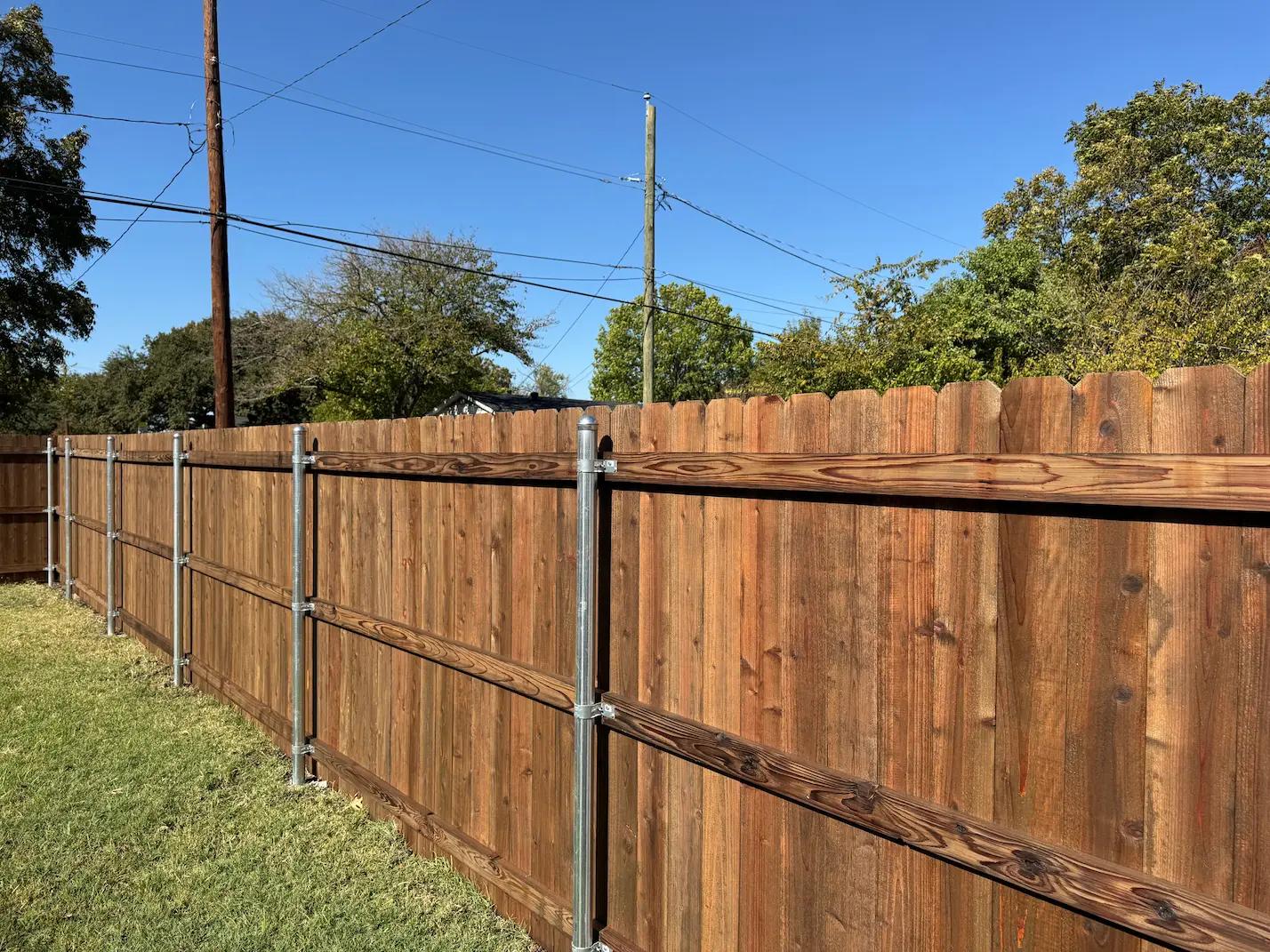
Many Dallas backyards use the existing perimeter fence as part of the pool barrier. If yours meets height and gap requirements, we can retrofit a code-compliant self-closing, self-latching gate without building a whole new enclosure. Worth knowing: safety experts still recommend a separate isolation fence between the house and the pool, because a perimeter fence does nothing about a back door left open.

We also get asked about frameless glass. It looks spectacular but is far more demanding to install and keep spotless than aluminum. For most families, mesh or aluminum meets the exact same code requirements with a lot less fuss — if glass is on your list, we'll give you a straight answer about whether your project justifies it.

04

Texas Pool Barrier Law and Dallas Code Basics

Pool fencing is one of the few corners of residential fencing that's genuinely regulated — at two levels.

State law. Texas Health & Safety Code Chapter 757, the Pool Yard Enclosures law, sets the statewide baseline: enclosures at least 48 inches tall measured from the side away from the pool, openings tight enough that a 4-inch sphere can't pass under or through the barrier, and nothing climbable — equipment, planters, structures — placed where it helps a child over. Chapter 757 directly governs multi-unit rental and HOA pools, but North Texas cities pattern their residential ordinances on the same requirements.

City code. Dallas and its suburbs require residential pool barriers at least 4 feet high with self-closing, self-latching gates and no gap a young child could squeeze through. The recurring inspection points:

  • Minimum 48-inch height along the entire fence line
  • No more than a 4-inch gap under the bottom rail or mesh border
  • Gates that close and latch on their own from any open position
  • Latch release mounted 54 inches up, or on the pool side, out of a child's reach
  • Gates swinging outward, away from the pool
  • No horizontal rails or footholds on the outside face
  • If a house wall forms part of the barrier, doors into the pool area carry their own requirements

Exact rules vary city by city and can depend on when your pool was permitted — Highland Park and a 1990s Plano build won't be inspected identically. We confirm current requirements with your city before we build, handle the inspection process, and guarantee compliance: every pool fence we install passes the first time. One more practical reason to get it right — most homeowner's insurance policies require a compliant pool barrier, and a failing one can put your coverage at risk or get a claim denied.

05

Dallas Pool Fence Self-Audit: 10 Checks Before Inspection

Buying a house with a pool, prepping for a city inspection, or just haven't looked hard at your fence since it went in? This is the walk-around we do at every safety assessment. It takes ten minutes, a tape measure, and a 4-inch ball — a softball works.

  1. Height: at least 48 inches everywhere, measured at the lowest ground point, not the highest.
  2. Bottom gap: no more than 4 inches between fence and ground — watch for settled mulch and eroded soil.
  3. Sphere test: the ball shouldn't pass through any gap in or under the fence.
  4. Gate closes itself from fully open and from barely ajar — the three-inch test is where tired hinges fail.
  5. Gate latches itself every time, without a push.
  6. Latch height: release at 54 inches or higher, or on the pool side of the gate.
  7. Swing direction: the gate opens away from the pool.
  8. Climb check: no horizontal rails, cross-bracing, or decorative footholds on the outside face.
  9. Nearby climbables: patio furniture, planters, pool equipment, or AC units beside the fence can turn a compliant barrier into a ladder.
  10. Mesh-specific: tension tight with no sag, every pole seated in its sleeve, no tears or detached borders.

Any box you can't check is worth a phone call. We offer free pool safety assessments across Dallas — we'll inspect the existing barrier, flag exactly what fails, and lay out the fix. No scare tactics, just the list.

06

Our Pool Fence Installation Process and Warranty

  1. Free onsite estimate. We measure the pool area, check your city's current barrier rules, and walk you through the mesh, iron, and aluminum options so you can pick the right barrier for your yard.
  2. Layout and materials. We map anchor points or post lines around your deck, coping, and equipment, and set gate placement where you actually walk.
  3. Installation. Most removable mesh systems go in within a day; iron and aluminum enclosures typically run one to two days depending on footage.
  4. Safety check and inspection. We test every gate — closure, latch, swing direction — verify heights and gaps, and support the city inspection so your fence passes the first time.

Every pool fence we install is covered by our 5-year workmanship warranty.

We install pool fencing throughout Dallas and the northern suburbs, including fence installation in Plano, fence installation in Frisco, and the pool-dense blocks of Highland Park and University Park.

Ready to secure your pool? Call (469) 809-2424 or request a free estimate online. Not sure whether your current fence passes? Start with the free safety assessment — worst case, you get a clean bill of health.

Where we work

Pool Fence Installation across the DFW metroplex

We install in Dallas and every surrounding suburb. A few of the cities we serve most — don't see yours? Just ask .

More from Dallas Fence

Explore our other fence services

One crew for every fence on your property. Whatever you're building next, we install it.

Frequently asked questions

Common questions about pool fence installation in the Dallas area.

Texas Health & Safety Code Chapter 757 sets the baseline — a barrier at least 48 inches tall with openings a 4-inch sphere can't pass — and Dallas-area cities apply the same core requirements to residential pools through local code.
At least 48 inches (4 feet), measured on the side away from the pool. We install 4-foot and 5-foot systems; many parents choose 5-foot mesh for extra climb margin.
Yes — the gate must close and latch on its own, swing away from the pool, and keep its latch release at least 54 inches high or on the pool side, out of a child's reach.
Every fence we install is built to your city's current pool barrier code, and we handle the inspection process — our fences pass the first time.
Yes — an adult can unlatch the sections, lift the poles from their deck sleeves, and roll the panels for storage in about 10 to 15 minutes, then reinstall them just as fast.
A four-sided isolation fence is the most effective single layer of drowning prevention for children and pets — though no barrier replaces adult supervision.
Most removable mesh systems install in a single day; iron and aluminum pool enclosures typically take one to two days depending on footage.

Ready for your pool fence installation project?

Free on-site estimate, no pressure. Licensed, insured, and backed by our 5-year workmanship warranty.