
Skip to content
Dallas Fence Company
Automatic driveway gate installation in Dallas, TX
Automatic Gate Systems

Automatic Gate Installation & Repairs in Dallas, TX

Automatic gate installation & fast gate repair in Dallas. Swing, slide & solar gates, keypad or app access, 5-year warranty. Call (469) 809-2424.


Automatic Gate Installation & Repairs

01

Secure Your Entryway with Automatic Gates

A driveway gate does two jobs at once: it decides who gets onto your property, and it sets the tone for everything behind it. Dallas Fence Company installs and repairs automatic driveway gates across the city — swing, slide, cantilever, and solar-powered systems, plus the operators, keypads, and intercoms that run them. Every new installation carries our 5-year workmanship warranty.

If your gate is already misbehaving — stuck half-open, ignoring the remote, grinding on the track — you're in the right place too. Repair is a full half of our gate work, and we service every major operator brand, not just the ones we sell. We fabricate custom steel-framed gates, install LiftMaster, Apollo, Ghost Controls, Viking, and DoorKing operators sized to the gate's weight and cycle count, and set up access control from keypads to smartphone apps. Call (469) 809-2424.

02

Gate Types and Which One Your Driveway Needs

The right gate depends on your driveway, not the other way around. Here's the lineup:

  • Single swing gate — one panel on heavy-duty hinges, up to 16 feet. Simplest to automate and easiest to maintain, but it needs level ground for the swing arc.
  • Double swing gate — two panels meeting in the center for 24-foot-plus openings, each with its own operator arm. The classic estate look, and it halves each panel's clearance.
  • Slide gate — travels a ground track parallel to your fence line. No swing clearance, so it's the answer for short setbacks, sloped drives, and windy open lots.
  • Cantilever gate — a slide gate with no ground track. It floats across on rollers, nothing to jam with gravel or leaves — the low-maintenance pick for gravel and uneven ground.
  • Pedestrian gate — a smaller automated gate for foot traffic at a side entrance or pool, with self-closing keypad or intercom access.
  • Solar-powered gate — any of the above, run off a panel and battery instead of a trenched line, which usually wins the math on a gate far from the house.

Most homeowners pick a style off looks and regret it when the site fights back. Four questions settle it before you fall in love with a design:

  • Is the ground flat and open? A swing gate needs a clear arc swept clean inside the opening. A driveway that climbs toward the house makes a swing panel drag the grade or hang high with a gap at the bottom. Flat says swing; sloped says slide.
  • How short is the setback? A gate close to the street can't swing without blocking the sidewalk. A slide gate needs zero swing room — just a run of fence beside the opening to retract into.
  • How exposed is the lot? Straight-line winds turn a tall swing panel into a sail. On open lots, a low-anchored slide or cantilever holds up where a swing arm fights every gust.
  • What's under the drive? A slide track collects gravel and leaves; on a gravel or unpaved drive, a cantilever gate skips the track and floats across on rollers.

Short version: flat, paved, deep setback, sheltered — a swing gate is simpler and looks great. Sloped, tight, windy, or gravel — a slide or cantilever earns its keep. Toss-up? We'll tell you which way we'd go on your lot.

03

How Will You Open Your Gate?

Access control is where a gate becomes a convenience, not just a barrier. Most Dallas homeowners combine two or three:

  • Smartphone app — open the gate from anywhere, hand out temporary codes to guests and deliveries, and get an alert every time it cycles. LiftMaster's myQ does this.
  • Keypad and remotes — a PIN pad at the driveway plus visor clickers for the cars. Give the housekeeper her own code, delete it when it's done, and never hand out a key.
  • RFID card and tag readers — a windshield tag opens the gate as you roll up, no button to press. Handy where several drivers come and go daily.
  • Video intercom — see and talk to whoever's at the gate before it opens, from the kitchen or out of the country.
  • Free-exit loop — a sensor wire under the driveway that opens the gate as you drive out. No fishing for a remote to leave home.

We install LiftMaster (premium reliability plus myQ smart control), Apollo (strong value, solar-compatible), Ghost Controls (built for solar), Viking (commercial-grade for big, high-cycle gates), and DoorKing access systems — matched to the gate's weight and daily cycle count, not to whatever's on a shelf.

04

Safety Sensors and UL 325 — Not Optional

An automatic gate moves several hundred pounds of steel on a motor that can't feel what it hits. That's why UL 325 — the standard every compliant gate operator is built to — requires at least two independent means of entrapment protection on the closing path, so if one fails the second still catches. In practice, that's a combination of:

  • Photo eyes — an infrared beam across the opening. Break it and the gate stops or reverses instead of closing on a car, a dog, or a kid on a bike. This is the sensor that most often drifts out of alignment and leaves a gate refusing to close.
  • Contact edges — a pressure-sensitive strip along the leading edge. Touch anything at all and it signals the operator to reverse on the spot.
  • Inherent obstruction sensing — the operator watches its own motor load and backs off when the gate meets resistance.

We install and test these on every job and tune the sensitivity to protect without nuisance-reversing on every stray leaf. If your gate has a dead photo eye or a missing edge — common on older systems — it's running without the redundancy the standard requires, and we'll fix that.

05

Automatic Gate Repair in Dallas

This is the call we get most: the gate worked for years, and now it doesn't. We diagnose and repair every major operator brand, including systems we didn't install.

The failures we see every week

  • Gate won't move at all — tripped breaker, dead backup battery, failed motor, or a cooked control board. Dallas heat is brutal on boards and batteries; they're the most common casualties of a triple-digit August.
  • Opens but won't close — almost always the photo eye safety sensors: blocked, filthy, or knocked out of alignment by a bumper or a weed trimmer.
  • Slow, straining, or grinding — worn gears, sagging hinges, or debris packed into a slide track. Easy to fix now, a bigger repair if you wait.
  • Reverses for no reason — a mis-set limit switch, an over-sensitive obstruction setting, or a failing contact edge.
  • Shrinking remote range — a dying remote battery or a failing receiver antenna, or a cracked enclosure letting a downpour corrode the board.

Every repair starts with a diagnosis and a firm quote — no work until you approve it. If a fifteen-year-old operator is on its third failure, we'll tell you straight when replacement beats another patch — operators typically give 10–15 years before the math flips.

A gate stuck closed across your driveway isn't a next-week problem. Emergency calls jump our schedule — call (469) 809-2424 and we'll get you moving.

What to Check Before You Call

Five minutes of checking saves some homeowners a service call:

  1. Power. Check the breaker feeding the gate and any GFCI outlet on the circuit — after a storm, this fixes more "dead" gates than anything else.
  2. Remote batteries. If the keypad works but the remote doesn't, swap the remote battery before assuming worse.
  3. Photo eyes. Wipe the two small sensors near the bottom of the opening, clear weeds and webs, and confirm they point at each other — a gate that opens but won't close is usually this.
  4. Track and hinges. Clear gravel or branches from a slide track; on a swing gate, watch for a panel dragging the ground — that's hinge sag the operator fights every cycle.
  5. The manual release. Every operator has one to move the gate by hand if you're trapped in or out. Find it before you need it in the dark.

If all five come up clean, the problem is electrical or mechanical — that's our job. Don't open the housing or probe wiring; just tell us what the gate does and we'll usually show up already knowing what we're fixing.

06

Built for Dallas Heat, Storms, and Estate Streets

Gate systems in North Texas fail differently than they do anywhere mild. We build for the conditions:

Heat and wind. Control boards, capacitors, and backup batteries degrade fast inside a metal enclosure baking through a Dallas summer — an unshaded, south-facing box can push past 130°F on a triple-digit afternoon. We ventilate housings deliberately, spec weather-rated enclosures, and lean on DC operators whose batteries handle the heat cycles better. On exposed lots we favor slide gates that anchor low against straight-line gusts, on posts set deep enough to hold in high-wind soil.

Storms and outages. Spring storms cut power exactly when you want the gate working. Battery backup keeps it cycling through an outage, and we'll walk you through the fail-safe versus fail-secure decision — whether your gate should release or hold locked when power dies. Solar rigs skip the question entirely.

Estate and HOA standards. Automatic gates are the norm on estate lots in Preston Hollow and Highland Park, where architectural boards usually want drawings before anything gets built — we produce the spec sheets and renderings that get approvals through. Farther north, gated properties along the busier North Dallas corridors are quickly becoming standard.

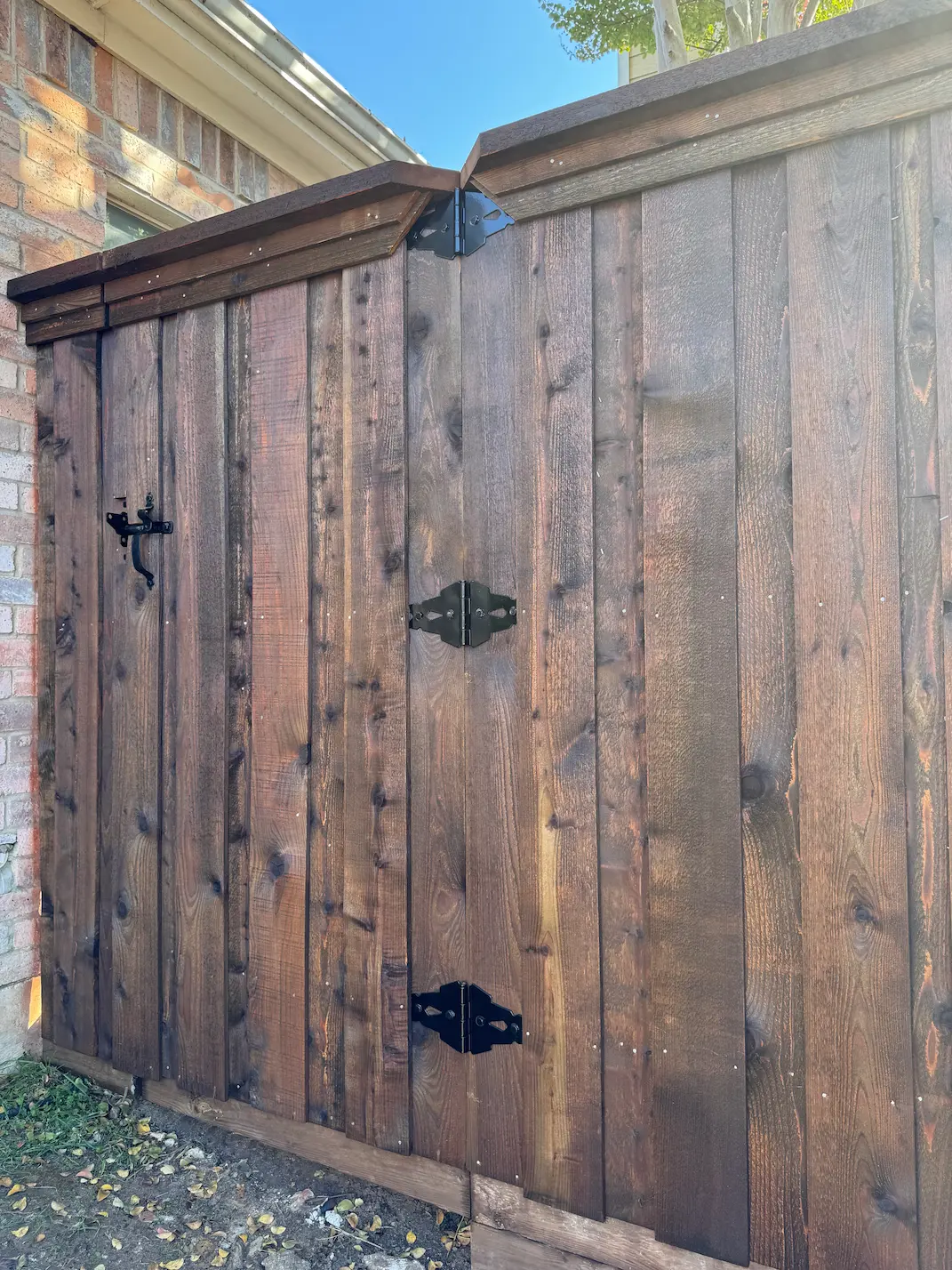
Matching the fence. A gate shouldn't look bolted on. We fabricate gates alongside our iron fence installation for the classic estate perimeter, and build steel-framed wood gates that match a cedar privacy fence without the sag that kills wood-on-wood gates within two summers.

07

The Dallas Gate Installation Process

  1. Site visit. We measure the opening, check slope and drainage, locate power, and talk through how you'll actually use the gate.
  2. Design and quote. Gate style, operator, safety sensors, and access control, laid out as one firm plan.
  3. Fabrication and posts. We build the gate, then set posts — plus concrete pads or tracks for slide gates — plumb and deep.
  4. Automation. Operator, UL 325 safety sensors, and access devices installed, programmed, and tested through full open-close cycles.
  5. Walkthrough. You learn the system — codes, app, manual release — before we leave. Then the 5-year workmanship warranty clock starts.

Most residential installs wrap up within a few working days once fabrication is done.

A gate is only as strong as the fence beside it, and we handle the whole perimeter — wood fences, iron fencing, chain link, privacy fences, pool enclosures, security fencing, Trex composite, and aluminum fencing across Dallas and the metroplex.

Ready for a gate that works every single time? Call (469) 809-2424 or request your free estimate online.

Where we work

Automatic Gate Installation & Repairs across the DFW metroplex

We install in Dallas and every surrounding suburb. A few of the cities we serve most — don't see yours? Just ask .

More from Dallas Fence

Explore our other fence services

One crew for every fence on your property. Whatever you're building next, we install it.

Frequently asked questions

Common questions about automatic gate installation & repairs in the Dallas area.

Swing gates suit flat driveways with room for the panels to arc; slide and cantilever gates win on sloped driveways, short setbacks, and windy open lots because they travel parallel to the fence line instead of swinging into space you don't have.
Yes — a solar panel and battery bank usually beats trenching electrical out to a gate far from the house, and Dallas sun keeps the battery charged year-round.
Keypads, rolling-code remotes, smartphone app modules, RFID card and tag readers, video intercoms, and in-ground exit loops that open the gate automatically as you drive out — most homeowners combine two or three.
Yes. UL 325 requires at least two independent means of entrapment protection — typically photo eyes plus a contact edge — so the gate stops or reverses instead of closing on a car, pet, or child. We install and test them on every job.
The usual culprit is the photo eye safety sensors — blocked, dirty, or knocked out of alignment — because the operator is designed to hold the gate open rather than close it across an obstruction it can't verify.
Most Dallas repair calls get a technician within a day or two, and emergencies — a gate stuck closed across your driveway — jump the line. Call (469) 809-2424.

Ready for your automatic gate installation & repairs project?

Free on-site estimate, no pressure. Licensed, insured, and backed by our 5-year workmanship warranty.