
Skip to content
Dallas Fence Company
Aluminum fence installation in Dallas, TX
Aluminum Fence Experts

Aluminum Fence Installation in Dallas, TX

Aluminum fence installation in Dallas, TX: rust-proof, low-maintenance, pool-code ready. Iron looks without the upkeep. Free estimate at (469) 809-2424.


Aluminum Fence Installation

01

Rust-Proof Aluminum Fencing in Dallas

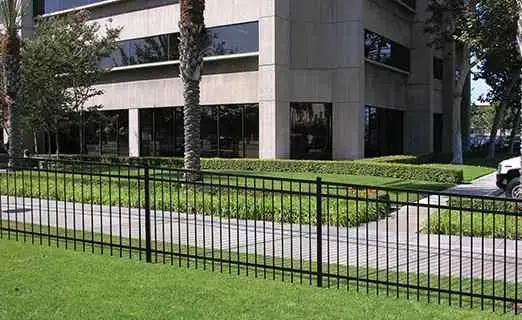
Aluminum is the fence that looks like wrought iron and forgets to age. It never rusts, it never needs repainting, and it holds a clean line for decades. For Dallas homeowners who want an open, ornamental look around a front yard, a pool, or a garden — without the upkeep iron demands — it is usually the right call.

Dallas Fence Company installs powder-coated aluminum fencing across Dallas and the northern suburbs, and every job carries a 5-year workmanship warranty. If a panel racks loose or a gate sags because of our work, we come back and fix it.

Here is the science that makes aluminum different, and it matters: aluminum contains no iron, so it cannot form rust. The instant bare aluminum meets air, it grows a thin, hard oxide layer that seals the surface and stops corrosion in its tracks — and that layer heals itself if scratched. Chlorine splash, sprinkler overspray, a humid week in May — none of it eats aluminum the way it eats raw iron. That is why aluminum is the default around pools and why the buried section of an aluminum post will never rot off at the ground line the way iron and steel eventually can.

02

Aluminum Fence Grades: What You Are Actually Paying For

Not all aluminum fence is the same fence, and the gap between a flimsy panel and a solid one usually comes down to one number you never see on the brochure: wall thickness. Thicker extrusion walls mean stiffer pickets and rails that do not flex when a kid leans on them or a mower nudges them.

The industry sorts aluminum into grades. Names vary by manufacturer, but the progression is consistent:

  • Residential grade — thinner-wall 5/8-inch pickets. Fine for property lines, pets, and curb appeal at 3 to 6 feet. The lightest panels live here, and the thinnest of those flex.
  • Commercial grade — heavier 3/4-inch pickets with thicker walls and larger rails. Built for schools, apartments, pools, and HOA communities where the fence takes abuse. Handles 4 to 8 feet.
  • Industrial grade — 1-inch pickets, the thickest walls. Security sites, utilities, and high-wind exposure.

Exact wall thicknesses shift a few thousandths of an inch between makers, so we spec to your use rather than a marketing label. One honest recommendation: on a lot of higher-end Dallas homes, we put in a commercial-grade picket even on residential jobs. North Texas wind, big dogs, and lawn equipment are hard on a thin-wall residential panel. Step up the picket once, skip the leaning panel in year six.

03

Aluminum Fence Styles and Heights

Aluminum comes in more looks than iron, and the factory finish is dead consistent panel to panel. The styles we install most:

  • Flat-top (2-rail and 3-rail) — clean, modern, and the most common residential choice. Three-rail adds rigidity for taller runs.
  • Spear-top / pressed-point — classic pointed pickets for an ornamental, iron-like front yard. A mild deterrent to climbing, too.
  • Staggered spear — alternating tall and short spears for a more decorative top line.
  • Puppy-picket — an extra row of tighter pickets along the bottom rail to keep small dogs and pets from slipping through. Popular in Dallas neighborhoods with small breeds.

Standard heights run 3, 4, 5, 6, and 8 feet. Four feet is the front-yard and pool-adjacent standard; six feet is the backyard security and privacy-of-sightline choice. Black is the default color in DFW, but bronze, white, and custom shades are available.

04

Aluminum Pool Fences and Dallas Code

Aluminum is the material we recommend most for pool enclosures, and code is a big reason why. A rust-proof, vertical-picket fence checks nearly every box a pool inspector looks for.

Texas residential pools follow the international pool and residential codes, and the core requirements are consistent across the Dallas area:

  • At least 48 inches tall, measured on the outside.
  • No opening lets a 4-inch sphere through — which is why pool-grade panels use tighter picket spacing (under about 3-15/16 inches).
  • No more than 2 inches of gap under the bottom rail.
  • Self-closing, self-latching gate that opens away from the pool, with the release at least 54 inches above grade if it is on the outside.
  • No climbable horizontal rails on the outside face — vertical-picket aluminum satisfies this by design.

One catch worth knowing: local rules override the baseline. Most DFW cities enforce the 48-inch minimum, but some Texas cities require 60 inches, so the height that passes in one suburb can fail in another. We confirm the code for your specific address, build to it, and handle the inspection. The full walkthrough lives on our pool fence installation page.

05

Racking for Dallas Slopes and Clay Soil

Dallas yards roll. They sit on expansive clay that swells in the wet season and shrinks in the dry, so the ground under a fence line is rarely flat and never perfectly still. Aluminum handles this better than almost anything, because aluminum panels rack.

Racking means the panel parallelograms: the rails pivot at each picket connection so the fence follows the grade while the pickets stay plumb and the bottom rail hugs the ground. The alternative — stepping, where each level panel drops down in stairs — leaves triangular gaps under the fence and a jagged top line. Racking closes those gaps and keeps a clean, continuous top edge.

Standard residential rackable panels handle roughly 12 to 20 inches of rise over a 6-foot section; heavier commercial panels do more. On the gently rolling lots common in Richardson, Coppell, and Farmers Branch, that is usually plenty to follow the grade without a single stair-step.

Then there is the soil. North Texas clay heaves and settles seasonally, and that movement is what leans and lifts fence posts that were set too shallow. We set aluminum posts 36 to 48 inches deep in wider concrete footings — deep enough to anchor below the most active moisture zone — with gate posts set deeper and doubled in concrete so heavy gates never sag. And because aluminum does not rust below grade, the buried part of the post is never the thing that fails.

06

Aluminum vs. Iron: An Honest Comparison

We install both aluminum and iron, so we have no reason to oversell either. Here is the straight version.

Aluminum wins on maintenance and lifespan. It never rusts, needs no repainting, outlasts iron with less upkeep, and is code-friendly for pools. For most Dallas homes, front yards, gardens, and pool enclosures, it is the smart pick.

Iron wins on brute strength and ornamental character. It is heavier, more rigid, and takes fully custom fabrication and ornate detail that aluminum cannot match. If you want maximum security or a one-of-a-kind hand-built look and you accept a repaint every few years, iron earns its keep. If you are weighing the two, our iron fence installation page lays out where iron pulls ahead and why.

The one place a low-grade aluminum fence fails is the finish — not the metal. Low-grade fences ship with a thin, basic powder coat that chalks and fades under Texas UV within a couple of seasons. A quality AAMA 2604 (5-year) or 2605 (10-year) fluoropolymer coating holds gloss and color for a decade or more. It is the single most useful question to ask any fence company: what is the coating spec? We use quality-coated material and set it on properly footed posts, then stand behind the whole job with our 5-year workmanship warranty.

Ready for a fence that looks like iron and ages like stone? Call (469) 809-2424 or request your free estimate online.

Where we work

Aluminum Fence Installation across the DFW metroplex

We install in Dallas and every surrounding suburb. A few of the cities we serve most — don't see yours? Just ask .

More from Dallas Fence

Explore our other fence services

One crew for every fence on your property. Whatever you're building next, we install it.

Frequently asked questions

Common questions about aluminum fence installation in the Dallas area.

No. Aluminum contains no iron, so it physically cannot form rust. Bare aluminum builds a thin, self-healing oxide layer that seals the metal and stops corrosion, even below grade. The finish is the real variable — a low-grade, thin powder coat chalks and fades under the Texas sun within a season or two, while a quality AAMA 2604 or 2605 coating holds color for 5 to 10-plus years. When you compare quotes, ask about the coating spec, not just whether it is 'powder-coated.'
For most Dallas homes and pools, aluminum. It never rusts, needs almost no maintenance, and lasts longer with less upkeep. Iron is stronger and takes more ornate custom work, but it rusts and needs repainting every 3 to 5 years. Choose iron for maximum brute-force security or a specific ornamental look; choose aluminum for a rust-proof, low-upkeep fence that still reads like iron from the curb. We install both and will tell you which fits your property.
Grades step up in strength: residential (thinner-wall pickets for property lines, pets, and curb appeal), commercial (thicker 3/4-inch pickets for schools, pools, apartments, and most HOAs), and industrial (1-inch pickets for security and high wind). What you feel is wall thickness — a residential picket flexes if you lean on it; a commercial picket does not. Exact specs vary by manufacturer, so we match the grade to your use. On many DFW homes we spec a commercial-grade picket, because it shrugs off wind, kids, and mowers.
It is one of the best pool-barrier materials. Aluminum is rust-proof around chlorine and sprinkler overspray, and vertical-picket panels meet pool code naturally. In Texas, a residential pool barrier must be at least 48 inches tall, block a 4-inch sphere (so pool-grade panels use tighter picket spacing), and use a self-closing, self-latching gate that swings away from the water with the release at least 54 inches up. Rules vary by city, so we confirm your local code and handle inspection. See our pool fence installation page for the full breakdown.
Yes, through racking. Rackable aluminum panels pivot at each picket connection so the fence follows the grade while the pickets stay vertical and the bottom hugs the ground — no stair-step gaps. Standard residential panels rack roughly 12 to 20 inches of rise over a 6-foot section, and heavier panels do more. On the rolling, clay-soil lots common across Dallas, racking keeps a clean top line and closes the ground gaps that matter for pets and pool-code compliance.
Decades. The aluminum itself never rusts, and a quality powder coat holds up 15 to 25-plus years with no repainting — just an occasional rinse. The weak point on a low-grade fence is the coating and the posts, not the metal. We set posts deep in concrete for North Texas clay and back every installation with a 5-year workmanship warranty.
Usually, yes — ornamental aluminum is one of the most HOA-friendly options in DFW, especially for front yards and pool enclosures where associations want an open, uniform look. Most HOAs regulate height, color, and style, and black powder-coated flat-top or spear-top aluminum is a common approved default. We review your covenants before quoting and prepare the approval paperwork so your fence passes review the first time.

Ready for your aluminum fence installation project?

Free on-site estimate, no pressure. Licensed, insured, and backed by our 5-year workmanship warranty.