Skip to content
Dallas Fence Company
Deer and ranch rail fence in the Dallas area
Ranch & Deer Fence

Deer & Ranch Fence Installation in Dallas, TX

Deer & ranch fence installation across the Dallas area: pipe, cable, ranch rail, fixed-knot & field fence for acreage. Free quote at (469) 809-2424.


Deer & Ranch Fencing

01

Ranch & Deer Fencing Built for North Texas Acreage

Fencing 5, 50, or 500 acres is a different job than fencing a backyard. The runs are longer, the ground is harder, the animals push back, and a shortcut you take at post number ten shows up as a leaning line a thousand feet later. Dallas Fence builds deer and ranch fence for acreage and rural properties across the DFW area, from pipe and cable that outlives its owner to 8-foot fixed-knot game fence that keeps whitetail off your hay and orchards.

We work on the properties the tract-home crews skip: hobby farms in Collin and Denton County, horse acreage near the lake towns, cattle operations that run to the county line. Every fence is backed by our 5-year workmanship warranty, so the line you pay for is the line that holds.

  • Livestock safety built into the spec, not bolted on afterward, with smooth surfaces and spacing chosen for the animal.
  • Runs that stay straight because posts are set to depth and corners are braced to take real tension.
  • Clear, defendable boundaries on acreage that has been subdivided and re-surveyed over the decades.
  • Deer and wildlife kept out of the gardens, orchards, and food plots they raid every North Texas winter.

Call (469) 809-2424 and we will walk your land, talk through what you are running, and lay out your options.

02

Types of Ranch & Deer Fence We Install

There is no single "ranch fence." What you build depends on the animal, the acreage, and how you plan to use the land. Here is the full lineup.

Pipe & Cable Fence

The gold standard for Texas horse and cattle properties. Heavy Schedule 40 steel pipe posts carry tensioned cable runs that shrug off leaning stock and last decades with almost no upkeep.

  • Extremely durable, 40-plus year service life
  • Safe and highly visible for horses
  • Minimal maintenance beyond occasional paint

Ranch Rail (2, 3 & 4 Rail)

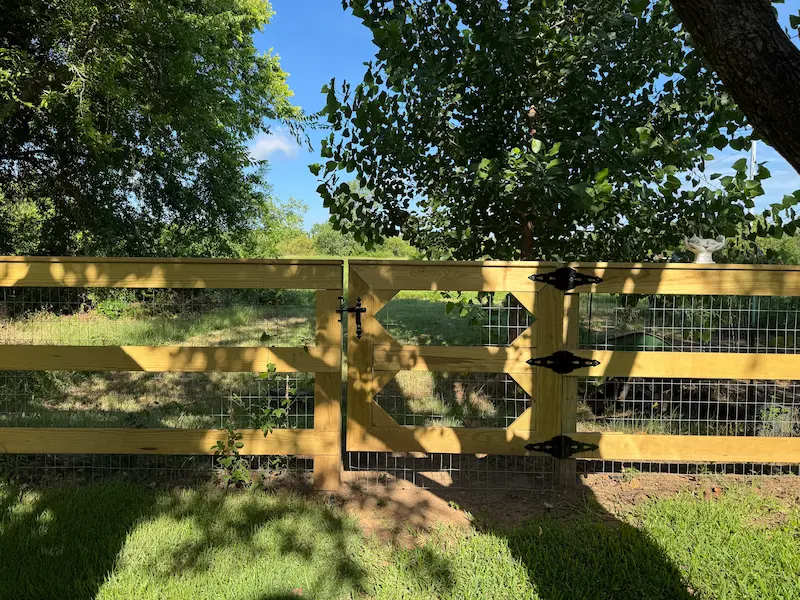
Classic horizontal-rail fencing in cedar or treated pine, or steel pipe for the long haul. Two rails frame a boundary, three rails is the ranch workhorse, and four rails (often paired with wire) locks down smaller or pushier animals.

  • Customizable rail count for the animal and the look
  • Cedar, treated pine, or welded pipe
  • Paint or stain to match the property

Fixed-Knot Wire

The current best-in-class wire for ranch and game work. A fixed knot locks each vertical and horizontal wire so the mesh holds its shape under impact instead of separating like old hinged-joint field fence. It handles 20-foot post spacing, so you cover more ground with fewer posts.

  • Outlasts and outperforms barbed and hinged-joint fence
  • Works for cattle, goats, exotics, and deer
  • Class 3 galvanized coating for a 25 to 30 year life

Field Fence & Woven Wire

The agricultural workhorse. Woven and field wire keeps goats, sheep, and smaller stock contained and defines the boundary with less material than rail. Mesh spacing is chosen for what you are keeping in and what you are keeping out.

  • Contains small and mid-size livestock
  • Multiple mesh patterns available
  • Galvanized against Texas humidity and rust

High-Tensile Smooth Wire

Efficient coverage for large acreage. Smooth high-tensile wire is stretched tight between braced ends, flexes on impact instead of snapping, and takes an electric charge cleanly for training or added deterrence.

  • Efficient across long perimeters
  • Flexes on impact to reduce injury
  • Electric-compatible

Deer & Game Fence

The 8-foot answer to North Texas whitetail. Built from fixed-knot mesh on steel line posts, it keeps deer, hogs, and other wildlife out of gardens, orchards, food plots, and croplands, and forms the perimeter for managed game acreage.

  • 8-foot working height for deer exclusion
  • Protects crops, gardens, and orchards
  • Fixed-knot mesh with predator wire and sight-block options

Crossbuck (X) Fence

Decorative ranch fencing with the "X" pattern between posts, that Kentucky horse-farm look for estate entrances, drive frontage, and upscale rural homes.

  • Premium, high-visibility appearance
  • White or natural finish
  • Estate-quality boundary
03

Matching the Fence Spec to Your Animals

Pick the fence for the animal, not the other way around. The wrong spec leads to escapes, injured stock, and work redone twice. Here is what holds each type.

Horses

Horses lean, crib, and spook, so you want smooth and visible with no edges to catch a leg. Pipe and cable, wood or pipe rail, or no-climb horse mesh are the safe picks. Never run barbed wire on a horse fence. Height should be at least 5 feet, 6 for stallions.

Cattle

Cattle test a fence with sheer weight. Fixed-knot wire, pipe and cable, or heavy woven wire all hold up. Barbed wire still works for cattle but demands ongoing tightening and repair. Standard height is 4 to 5 feet.

Goats & Sheep

The escape artists. Goats will find and exploit any gap, so tight-mesh woven or fixed-knot wire is non-negotiable, often with a hot wire top and bottom. Sheep are less determined but still want a full-coverage mesh. Plan 4 to 5 feet.

Deer & Wildlife

Exclusion is a height game. Most deer clear a 6- or 7-foot fence without trying, but fewer than 5% jump 8 feet, partly because their side-set eyes give poor depth perception and they will not commit to a leap they cannot read. Eight feet of fixed-knot game fence is the line that actually protects your crops.

Fence height, quick reference:

  • Horses — 5 to 6 feet
  • Cattle — 4 to 5 feet
  • Goats — 4 to 5 feet plus electric
  • Sheep — 4 feet
  • Deer exclusion — 8 feet

Running mixed stock? Build for the most demanding animal on the place. A fence that holds goats will hold everything else you turn out with them.

04

Posts, Soil, and Why North Texas Ground Matters

A ranch fence is only as good as what is holding it up, and North Texas ground is not kind to shortcuts. Much of the DFW region sits on expansive clay that swells when it rains and shrinks and cracks in an August drought. A post set too shallow gets heaved loose over a couple of wet-dry cycles, and then the whole run goes slack.

We set line posts deep enough to sit below that active zone, and set corner and brace posts deeper still, since those anchor the tension for the entire run. Game-fence and high-tension jobs get support posts down in the 5 to 6 foot range. Corners and gate ends are braced as H- or diagonal assemblies so a tensioned line cannot pull them out of plumb.

On pipe versus wood: Schedule 40 steel pipe is the long-haul choice, especially for horse and cattle rail and for corners that carry real load, and it laughs off the wet-dry clay cycle. Treated wood posts look right on a traditional rail fence, but they are the part that eventually rots at the groundline, so we spec them where the look calls for it and lean on steel where longevity matters most. Where the caliche or rock is genuinely hard, we bring the equipment to drill it rather than fight it with a shallow set.

05

Gates Sized for Trucks, Trailers, and Tractors

A gate too narrow for your equipment is a daily aggravation you will curse for years. We size ranch gates to what actually drives through them.

  • Walk gates — 4 feet for people and dogs
  • Standard drive and pasture gates — 12 to 14 feet for pickups, trailers, and most tractors
  • Equipment and double gates — 16 feet, or a double-swing pair, for hay equipment, larger implements, and cattle trailers
  • Cattle guards — for high-traffic entrances where you would rather not stop to open a gate at all

We build gates to match the fence they hang in, whether that is welded pipe on a ranch entrance, wire-filled frames on a field-fence line, or an automated drive gate at the road. If you want the entrance to open on its own, we also handle automatic gate installation and repair so trucks and trailers roll through without anyone climbing down in the rain.

06

The Dallas Fence Installation Process

  1. Site survey — We walk the property line with you, read the terrain, flag the corners and gate points, and note the clearing, creek crossings, and rock that affect the plan.
  2. Material selection — We match pipe, wood, cable, or wire class to your animals, acreage, and how you use the land, and lay out each option plainly.
  3. Installation — We clear the line, set and brace posts to depth, and stretch rail or wire to proper tension so the run stays straight and tight.
  4. Final walk — We check every gate, brace, and tension point for livestock security and fence integrity before we call it done.

Fencing acreage is a big investment, so it is worth doing once and doing right. Call (469) 809-2424 or request a free estimate and we will get out and walk your land.

If you are also squaring away the areas closer to the house, we build wood fence for pastures, corrals, and homesteads and durable chain-link fencing for kennels, arenas, and work areas. We fence acreage-adjacent communities across North Texas too, including ranch and horse properties around McKinney, larger lots in The Colony, and acreage near Lewisville.

Where we work

Deer & Ranch Fencing across the DFW metroplex

We install in Dallas and every surrounding suburb. A few of the cities we serve most — don't see yours? Just ask .

More from Dallas Fence

Explore our other fence services

One crew for every fence on your property. Whatever you're building next, we install it.

Frequently asked questions

Common questions about deer & ranch fencing in the Dallas area.

Eight feet. Studies show most deer clear a 6- or 7-foot fence, but under 5% jump an 8-footer, so 8 feet is the working standard for keeping whitetail off crops and gardens.
Two rails suit horses and decorative boundaries, three rails is the ranch standard for cattle and horses, and four rails (or a rail-plus-wire combo) contains smaller or more aggressive stock.
Yes. Running woven or field wire behind a pipe or rail fence is a common upgrade that keeps goats, sheep, and dogs in and predators out without losing the rail look.
Horses need smooth pipe, cable, or rail; cattle do well with fixed-knot, pipe, or heavy woven wire; goats and sheep need tight-mesh woven wire; deer exclusion needs an 8-foot game fence.
Plan 12 to 14 feet for tractors and trailers, and 16 feet or a double-swing setup for hay equipment and larger rigs. Walk gates stay at 4 feet.
Schedule 40 pipe fence lasts 40-plus years with occasional paint, fixed-knot wire runs 25 to 30 years, and treated wood rail typically lasts 15 to 20 years depending on stain upkeep.
We recommend a current survey before any perimeter fence. Rural acreage around DFW has been subdivided for generations, and a survey prevents boundary disputes and rebuilds.

Ready for your deer & ranch fencing project?

Free on-site estimate, no pressure. Licensed, insured, and backed by our 5-year workmanship warranty.